
HOA Backflow Testing for Apartments and Multifamily Properties: What Property Managers Need to Know
Backflow testing for an apartment complex or HOA is rarely as simple as testing one device at one address.
Multifamily properties may have several buildings, multiple shared water systems, locked access areas, resident communication requirements, annual deadlines, repair needs, and separate compliance records for every backflow prevention assembly.
For a property manager overseeing several communities, the process can become even more complicated. Each property may fall under a different water authority, with its own forms, deadlines, submission process, and testing requirements.
That creates a recurring administrative burden for:
HOA boards
Property managers
Community association managers
Apartment operators
Multifamily owners
Facilities teams
Multi-location property portfolios
Whether you manage a community in Denver, Las Vegas, Henderson, Durango, or elsewhere in Colorado, Utah, Nevada, Arizona, or Southern California, the basic goal is the same: identify every required device, complete testing on time, resolve failures, and submit the correct documentation.
This guide explains how HOA backflow testing works for apartments and multifamily properties, who is responsible, what systems may need testing, and how to stay compliant without turning it into another administrative headache.
What Is HOA Backflow Testing?
HOA backflow testing is the process of testing required backflow prevention assemblies that serve shared community systems. These systems may include irrigation, domestic water, fire suppression, pools, clubhouses, boilers, and other common areas.
A backflow prevention assembly helps stop water from flowing backward into the clean water supply. Reverse flow can occur when pressure changes create either backpressure or backsiphonage.
Backpressure happens when pressure within a property’s plumbing system becomes greater than the pressure in the public water supply. Backsiphonage happens when a drop in supply pressure pulls water in the opposite direction. Both conditions can introduce pollutants or contaminants into drinking water systems.
Shared systems at apartments and HOA communities can create potential cross-connections between potable water and sources such as:
Irrigation lines
Fertilizers and pesticides
Pool equipment
Fire suppression systems
Boilers
Mechanical equipment
Standing or stagnant water
Testing confirms that each required backflow prevention assembly is functioning correctly. Depending on the jurisdiction, the results may then need to be documented and submitted to the local water authority.
To learn more about how these devices work, readBackflow Testing: What It Is and Why It Matters.
Who Is Responsible for Backflow Testing at an HOA or Apartment Complex?
Responsibility for backflow testing usually falls to the property owner, HOA, property management company, or facilities team responsible for the shared system. The exact responsibility depends on the property’s ownership structure, governing documents, plumbing configuration, and local requirements.
It is important not to assume that an HOA is automatically responsible for every backflow device within the community.
Common-area systems are often managed by the HOA or property manager. Devices serving an individually owned unit or homeowner-controlled system may be handled separately. Local water-authority requirements and community governing documents should determine who is responsible.
For shared systems, the HOA, property owner, or management company is typically the party responsible for coordinating testing. For individually owned devices, responsibility may depend on the community’s governing documents and local rules.
HOA Communities
An HOA may be responsible for backflow prevention assemblies serving shared community assets such as:
Irrigation systems
Entry landscaping
Pools
Clubhouses
Community centers
Shared amenities
Common-area plumbing
Maintenance facilities
Larger communities may have several irrigation devices positioned throughout entrances, medians, green spaces, and other landscaped areas.
Apartment Complexes
Apartment owners and management companies typically coordinate testing for shared building and property systems.
These may include:
Centralized domestic water systems
Fire suppression systems
Irrigation systems
Shared mechanical systems
Pool or clubhouse equipment
Devices serving multiple buildings
Apartment testing may also require communication with maintenance teams, residents, tenants, and vendors who control access to mechanical rooms or other secured areas.
Condominium Communities
Responsibility within a condominium community may be divided among:
The condominium association
Individual building associations
Property management
Individual unit owners
For example, the association may manage devices serving irrigation and common amenities, while another party may be responsible for a building-level or unit-specific device.
Property managers should review the community’s governing documents and verify local requirements rather than relying on assumptions based on how another property handles testing.
Why Do Apartments and HOAs Need Backflow Testing?
Apartments and HOAs need backflow testing because shared plumbing, irrigation, fire protection, and amenity systems can create cross-connections that put the clean water supply at risk.
A cross-connection is a connection between a potable water supply and another system or source that may contain pollutants or contaminants. A functioning backflow preventer helps keep water from moving through that connection in the wrong direction.
Potential risks at multifamily properties include:
Irrigation water containing fertilizer or pesticide residue
Stagnant water inside fire suppression systems
Pool chemicals and equipment
Boiler water
Clubhouse kitchens and maintenance areas
Shared mechanical equipment
Pressure changes within larger plumbing systems
Hoses or maintenance equipment connected to potable lines
Backflow compliance is therefore more than a paperwork requirement. It helps protect:
Residents
Tenants
Property employees
Neighboring properties
Public drinking water
Building operations
The City of Phoenix, for example, operates a containment backflow prevention program specifically to protect the public water supply from possible contamination or pollution. Its plumbing requirements prohibit improper cross-connections and require appropriate backflow prevention methods.
Requirements differ between jurisdictions, but the underlying purpose is consistent: prevent potentially contaminated water from entering a potable water system.
What Backflow Devices Need to Be Tested at an Apartment Complex or HOA?
Each required backflow prevention assembly generally needs its own test and compliance record.
A multifamily property may have devices serving irrigation, domestic water, fire suppression, pools, clubhouses, boilers, or other shared systems. One successful test does not automatically satisfy the requirements for every device at the property.
Irrigation Systems
Irrigation is one of the most common locations for backflow prevention assemblies at HOA and apartment properties.
Devices may serve:
Entry landscaping
Common lawns
Medians
Courtyards
Recreation areas
Multiple irrigation zones
A large community may have devices distributed across several entrances or sections of the property, making an accurate inventory especially important.
Fire Suppression Systems
Apartment buildings, parking garages, clubhouses, and shared facilities may have backflow prevention assemblies connected to fire suppression systems.
These systems can contain stagnant water that should remain isolated from the potable supply. Testing may require specialized qualifications or coordination, so property managers should confirm that their provider is equipped to handle the specific type of fire-line assembly at the property.
Domestic Water Systems
Some apartment buildings and multifamily properties have backflow prevention assemblies serving the main domestic water supply.
These assemblies help protect potable building water and may be connected to building-level service lines. Larger properties with several buildings may have more than one domestic-water assembly.
Pools, Clubhouses, and Shared Amenities
Pools and amenity buildings can introduce additional cross-connection points.
Relevant systems may include:
Pool equipment
Clubhouse kitchens
Restrooms
Community gardens
Fitness facilities
Outdoor wash stations
Irrigation surrounding amenity areas
A property should not assume that all amenity-related systems are covered by the same assembly.
Boilers and Specialized Systems
Boilers, mechanical equipment, and other specialized systems can create pressure or cross-connection concerns.
The number and type of assemblies will depend on the property’s age, layout, equipment, and plumbing design. A qualified provider can help identify which known assemblies require testing, although the local authority ultimately determines compliance requirements.
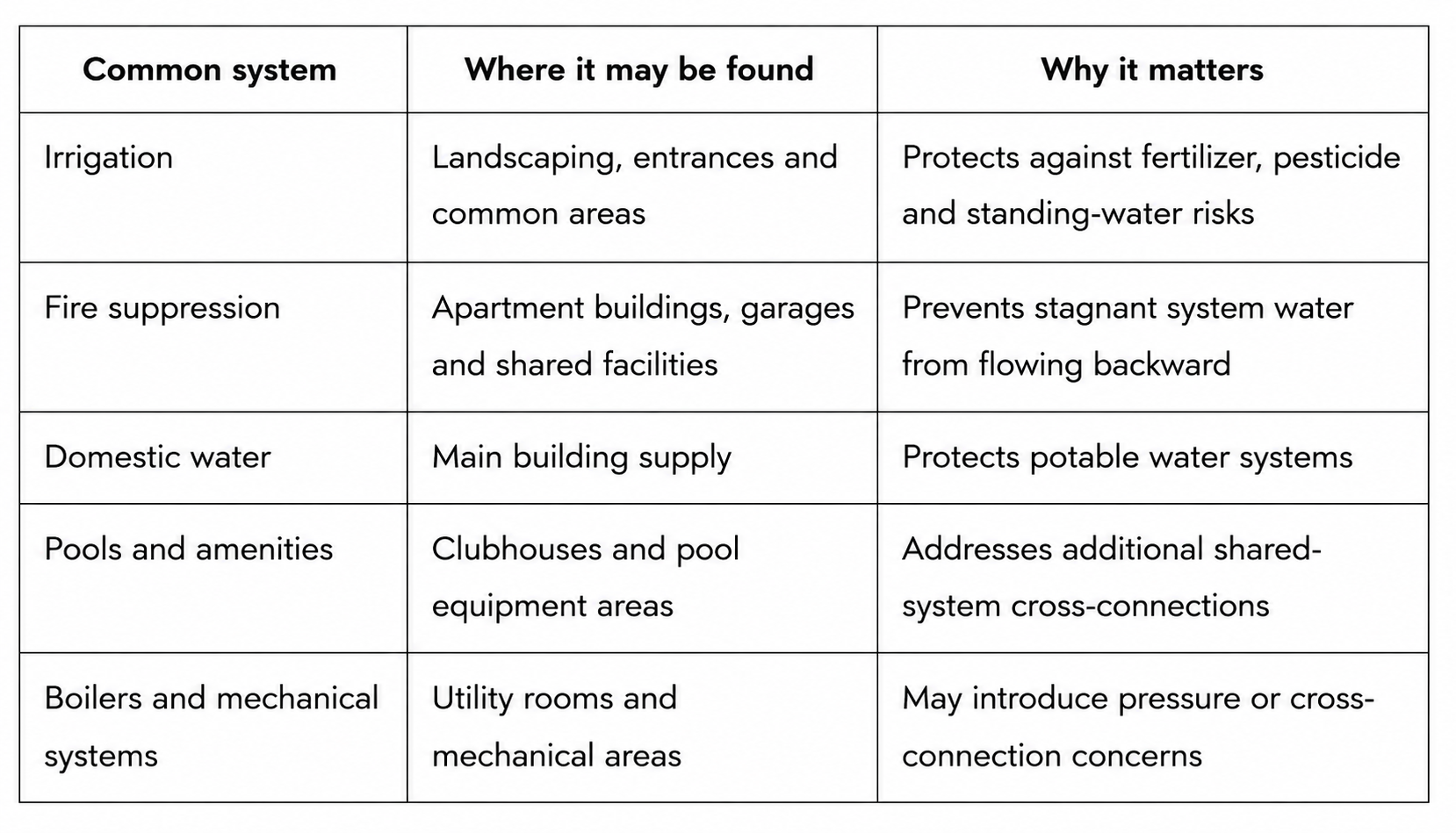
Common Backflow Systems at HOA and Multifamily Properties
How Many Backflow Devices Does an HOA or Apartment Complex Have?
The number of backflow devices varies according to the property’s size, layout, plumbing systems, amenities, and overall complexity.
There is no universal number.
A small community may have one required assembly serving an irrigation system. A large apartment complex may have separate assemblies for:
Multiple irrigation zones
Several buildings
Domestic water
Fire suppression
Pools
Clubhouses
Boiler systems
Additional mechanical equipment
Each device may require an individual test, result, submission, and compliance record. Some may also have different due dates depending on the local program.
For that reason, property managers should maintain an inventory rather than relying on the previous year’s invoice or assuming that every device was included.
The total number of devices also affects pricing. Integrity Backflow currently publishes commercial pricing tiers for properties with 1–5, 6–10, and 11 or more devices, allowing larger HOA and multifamily properties to receive lower per-test pricing as volume increases.
For a more complete pricing breakdown, read How Much Does Backflow Testing Cost?
How Often Is Backflow Testing Required for Apartments and HOAs?
Annual testing is common for required backflow prevention assemblies, but exact deadlines and submission rules vary by local water authority.
Property managers should not assume that “annual” means the device can be tested at any point during the calendar year. A property may have a specific due date based on its account, device, inspection cycle, or local program.
Additional testing may also be required after a device is:
Repaired
Replaced
Relocated
Newly installed
Returned to service
Phoenix, for example, requires annual testing and recordkeeping for applicable backflow assemblies and uses approved testing documentation as part of its program.
Requirements can differ significantly between Denver, Las Vegas, Henderson, Phoenix, Durango, and other service areas. A property manager overseeing multiple locations should verify the rule for each property rather than creating one universal portfolio deadline.
Looking for more region-specific requirements? Check out Backflow Testing Requirements: What Property Owners Need to Know for a broader explanation of annual compliance requirements.
Why HOA and Apartment Backflow Testing Is More Complicated Than Residential Testing
HOA and apartment backflow testing is more complicated than testing a single residential device because multifamily properties often have several systems, multiple devices, shared access points, resident considerations, and more administrative coordination.
Multiple Devices
Every required device generally needs to be:
Located
Accessed
Tested
Documented
Submitted to the appropriate authority
Some devices may pass while others fail. That means a single appointment can produce several different next steps.
Shared Access Areas
Devices may be located in:
Mechanical rooms
Locked utility spaces
Irrigation enclosures
Pool equipment areas
Garages
Rooftops
Gated sections of the property
Tenant-controlled spaces
The tester may need keys, gate codes, maintenance support, or advance access authorization. Missing access to one device can leave part of the property’s compliance work incomplete.
Resident and Tenant Coordination
Backflow testing is often minimally disruptive, but some systems require access planning or brief service coordination.
Residents may need advance notice when:
A device is located in a tenant-controlled area
A system must be temporarily isolated
A repair will affect water service
The provider needs access to a restricted building
Work will occur near a shared amenity
Clear communication helps prevent confusion and avoids unnecessary complaints.
Different Water Authorities Across a Portfolio
Multi-location property managers may deal with several water authorities.
Each authority may have its own:
Approved forms
Online portal
Tester requirements
Due dates
Submission procedures
Fees
Enforcement process
Using a centralized provider that understands local reporting requirements can reduce the number of processes the property manager must oversee.
Repair and Retesting Risk
A failed device adds another step to the compliance process.
The device may need to be repaired or replaced and then retested before passing documentation can be submitted. Waiting until the deadline leaves little room to complete this work.
A testing-only provider can also create additional vendor handoffs if another company must be called for the repair.
What Happens If an HOA or Apartment Complex Misses Its Testing Deadline?
Missing a required backflow testing deadline can lead to compliance notices, administrative escalation, penalties, and potential water-service issues, depending on the local authority.
Possible consequences include:
Reminder letters
Formal compliance notices
Fines or administrative fees
Accelerated repair requirements
Incomplete property records
Additional inspections
Water-service interruption in unresolved cases
Resident or tenant complaints
More work for the property-management team
Enforcement procedures are not identical in every city, so property managers should avoid assuming that the process used at one property applies everywhere.
For a multifamily property, even a relatively small compliance issue can become highly visible because many residents depend on the same shared systems. Scheduling testing before the deadline creates time to address failed assemblies without creating an urgent operational problem.
What Happens If One of the Backflow Devices Fails?
If a backflow prevention assembly fails its test, it usually needs to be repaired or replaced and then retested before the property can return to compliance.
The typical process is:
The tester identifies the failed component or test result.
The provider explains the problem and recommended next step.
The device is repaired or replaced.
The assembly is tested again.
Passing documentation is completed.
The results are submitted to the appropriate authority.
The property’s compliance records are updated.
A failed test does not always mean the entire device must be replaced. The appropriate solution depends on the assembly’s condition, age, parts availability, failure type, and repair cost. Does your backflow preventer need repair? Here are 5 signs it might.
Using one provider for testing, repair, replacement, retesting, and reporting can reduce delays and eliminate additional vendor coordination.
Integrity Backflow states that it offers licensed plumbing and backflow repair in-house, along with testing, compliance reporting, water-authority submission, and automated annual reminders.
How Much Does HOA Backflow Testing Cost?
HOA backflow testing costs depend on the number of devices, system types, property layout, accessibility, local requirements, and whether repairs or retesting are needed.
Several factors can affect the total:
Number of assemblies
Type of assemblies
Fire-line testing requirements
Number of buildings
Device accessibility
Distance between device locations
Local submission requirements
Failed tests
Repair or replacement needs
Retesting
Number of properties being coordinated
A property with more devices will usually have a higher total testing cost, although volume pricing may lower the cost per device.
Integrity Backflow currently publishes the following commercial testing tiers:
1–5 backflows: $115 per test
6–10 backflows: $95 per test
11 or more backflows: $80 per test
The company also states that reporting, submission fees, and travel fees are included rather than added separately. Property managers should confirm current pricing and the scope of service when requesting a quote.
For a complete explanation of pricing variables, read How Much Does Backflow Testing Cost? Real Pricing Breakdown.
How to Simplify Backflow Testing Across an HOA or Apartment Portfolio
The simplest way to manage multifamily backflow compliance is to use one organized process for testing, repairs, retesting, documentation, and annual reminders.
Keep a Device Inventory
Maintain a centralized record containing:
Property address
Building or community name
Device location
Device type
Manufacturer
Model
Serial number
Previous test date
Next deadline
Pass or fail result
Repair history
Submission status
This prevents devices from being missed when staff members, management companies, or service providers change.
Schedule Before the Deadline
Do not schedule testing for the final available day.
Earlier scheduling provides time to:
Repair failed assemblies
Order replacement parts
Coordinate access
Notify residents
Complete retesting
Correct paperwork problems
Resolve submission issues
It can also make it easier to coordinate several devices during one property visit.
Use One Point of Contact
A single point of contact can reduce:
Vendor handoffs
Duplicate communication
Confusing invoices
Scheduling delays
Missing records
Unclear responsibilities
For multi-property portfolios, centralized coordination gives the property manager better visibility into which communities are complete and which still require action.
Confirm Compliance Submission
Do not assume that the test report was automatically submitted.
Before hiring a provider, ask:
Does the tester submit results directly?
Are submission fees included?
Will the property receive confirmation?
Is a separate record created for each device?
Who handles rejected or incomplete reports?
Are repairs and retests added to the final submission?
Integrity Backflow states that its standard service includes compliance reporting and submission to the applicable local water authority.
Build a Repeatable Annual Process
A repeatable process may include:
Automated reminders
Centralized device records
A standard resident-notification template
Consistent reporting
One provider across multiple locations
Annual portfolio reviews
Early scheduling
A defined repair-approval process
The goal is to turn backflow testing from an annual scramble into a predictable property-maintenance task.
What to Look for in an HOA Backflow Testing Provider
Choose an HOA backflow testing provider that can handle multiple devices, local compliance submission, repairs, retesting, and recurring annual coordination.
Evaluate providers based on:
Certified testers
Commercial and multifamily experience
HOA and property-management experience
Multi-device scheduling
Multi-location service capabilities
Knowledge of local compliance processes
Documentation submission
Repair capability
Replacement capability
Retesting
Transparent pricing
Annual reminders
Responsive communication
Fire-line capabilities where needed
Ask exactly what is included in the quoted price. A low test price may not include travel, administrative charges, submission fees, repair coordination, or retesting.
The best provider is not simply someone who can perform a test. It is someone who can reduce the number of things the property manager has to track.
Before booking, make sure you follow this provider-selection checklist.
HOA Backflow Testing Is Easier When the Entire Process Is Managed Together
Multifamily backflow testing is more complicated than testing one residential device, but it does not have to be chaotic.
For HOAs, apartment complexes, condominium communities, and multifamily portfolios, backflow compliance involves more than one inspection. The property team must identify every required assembly, arrange access, meet local deadlines, handle failed devices, complete retesting, and ensure that the correct paperwork is submitted.
A coordinated process turns that recurring obligation into a predictable annual service.
Integrity Backflow provides commercial and HOA backflow testing across Colorado, Utah, Nevada, Arizona, and Southern California. Its published services include certified testing, compliance reporting, submission to the local water authority, in-house repair, and automated annual reminders.
Need backflow testing for an HOA, apartment complex, or multifamily portfolio? Request a quote or schedule service with Integrity Backflow today.
Common Questions About HOA Backflow Testing
Who is responsible for backflow testing in an HOA?
Responsibility for shared systems commonly falls to the HOA, property manager, or property owner. Devices serving individually owned homes or units may be handled differently depending on the community’s governing documents, plumbing structure, and local rules.
Do apartment complexes need annual backflow testing?
Required backflow prevention assemblies commonly need annual testing, but exact deadlines and requirements vary by local water authority. Testing may also be required after a device is installed, repaired, replaced, or relocated.
How many backflow preventers does an apartment complex need?
The number depends on the property’s layout and systems. Separate devices may serve irrigation, domestic water, fire suppression, pools, clubhouses, boilers, individual buildings, and other shared systems.
Does every apartment unit need its own backflow test?
Not necessarily. Many multifamily properties have shared backflow devices serving building-level or common-area systems. The devices that require testing depend on the property’s plumbing configuration and local requirements.
Can one provider test every backflow device in an HOA community?
Often, yes. A provider with commercial and HOA experience can coordinate testing across several devices, buildings, and common areas. The provider may also handle reporting, repairs, replacement, and retesting when needed.
What happens if one HOA backflow device fails?
The failed assembly generally needs to be repaired or replaced and then retested. After it passes, updated compliance documentation is submitted to the applicable water authority.
Can backflow testing be scheduled with minimal disruption to residents?
Usually, yes. The provider should confirm device locations, access requirements, and whether any systems need to be temporarily isolated. Advance communication is especially helpful when devices are located in tenant-controlled or restricted areas.
Does the tester submit the HOA’s compliance paperwork?
Some providers submit test results directly, while others only provide the completed report to the property manager. Confirm reporting and submission responsibilities before booking. Integrity Backflow states that compliance reporting and submission to the local water authority are included in its service.
